
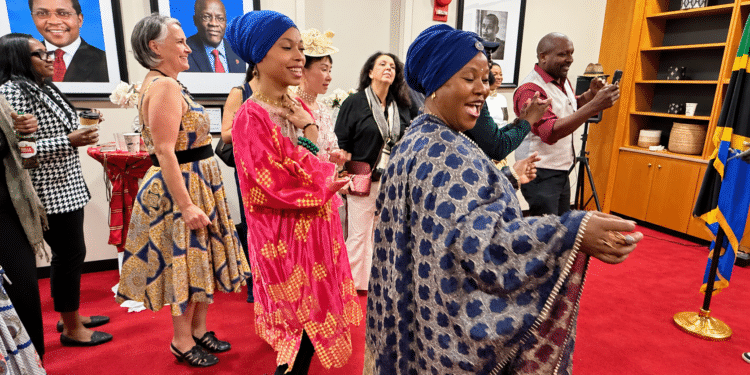
H.E. Ambassador Elsie Sia Kanza welcomed guests to the Embassy of the United Republic of Tanzania in Washington, D.C., on October 15, 2026, for an introduction to Tanzania’s culture and tourism through food, music, and conversation. Organized in partnership with Things To Do DC, the reception also explored the country’s history, development priorities, and ties with the United States.
“It is a great pleasure to welcome you all to Tanzania House,” Ambassador Kanza said. “We are happy to have you here, and delighted to offer you a glimpse into the rich culture, enduring traditions, and warm hospitality for which Tanzania is known.”
She thanked Gregory Bland, CEO of Things To Do DC, and his team for their partnership, greeting him in Kiswahili as “Kaka,” meaning brother.
The reception took place a day after Nyerere Day, observed on October 14 in memory of Tanzania’s founding President, Mwalimu Julius K. Nyerere. Ambassador Kanza discussed his role in the country’s history and the union of Tanganyika and Zanzibar on April 26, 1964.
She spoke about Tanzania’s ethnic diversity and the importance of Kiswahili as a shared language. Describing a country with more than 123 ethnic groups, she said Tanzania was “very proud of the example we serve universally of unity in diversity.”

Her account included Tanzania’s support for African liberation movements. Dar es Salaam hosted the headquarters of the Organization of African Unity’s Liberation Committee, which supported struggles against colonial rule and apartheid.
She also pointed to connections that guests could explore in the United States. These included the Kiswahili vocabulary used in Kwanzaa and casts of the Laetoli footprints at the Smithsonian’s National Museum of Natural History in Washington. Dating back about 3.7 million years, the footprints are part of Tanzania’s contribution to the study of human origins.
Turning to the economy, Ambassador Kanza discussed investment in transport infrastructure, including the Standard Gauge Railway and its planned connections with neighboring countries. She described Development Vision 2050, which sets out Tanzania’s ambition to become a trillion-dollar economy, with substantial investment expected from the private sector.
Conservation was another subject. She described communities as “the first stewards” of Tanzania’s natural heritage and discussed their role in protecting the landscapes and wildlife that attract visitors to the country.
Tourism provided a direct connection with the United States, which she identified as Tanzania’s leading source of international visitors. She also recalled the arrival of Peace Corps volunteers in September 1961, before Tanganyika gained independence, and cited sister-city relationships as another means of maintaining contact between the two countries.
“Our relations are built to endure,” she said, “because they’re rooted in people-to-people relationships.”
Guests continued their conversations over a buffet prepared by a Tanzanian chef. Written information near the food provided historical context, while Tanzanian beer and wine accompanied the meal.
Ambassador Kanza had made clear that guests should also be prepared to dance.
“We will be taking count of everyone who does not dance,” she said.
Singer Jumbe Hamza, who performs as Mr.Tz and is also known as SanTz, led the musical performance. His repertoire drew on Bongo Flava and Mduara, with selections exploring identity, memory, and social behavior.
“Natokea Wapi,” translated during the event as “Where am I from?”, considered questions of origin and belonging. The explanation accompanying the song connected its subject to the experience of Tanzanians living abroad and their efforts to retain their language and traditions.
“Zilipendwa” introduced guests to older, much-loved songs and the memories associated with them. “Vidudu Watu” took a more critical approach. As explained at the reception, its insect imagery referred figuratively to people who exploit or trouble others.
These explanations helped guests follow the subjects of the songs as well as their rhythms. They also provided an introduction to the use of humor and figurative language in Tanzanian music.
Guests eventually joined the dancing, taking up the Ambassador’s invitation to participate. Her earlier instruction had left little room for hesitation: “I invite you to enjoy this taste of Tanzania. We’ll hear vibrant music, so, enough speeches.”
